Article Snapshot
Washer Repair Cost at a Glance
Average washer repair cost: $140–$450
Average service call: $75–$125
Least expensive repair: Lid switch, drain hose, or inlet valve replacement
Most expensive repair: Transmission, drum bearing, or electronic control board replacement
Average washer lifespan: 10–14 years
Worth repairing?
In many cases, yes. Repairing a washing machine is often worthwhile when the appliance is less than 10 years old and the repair costs less than half the price of a comparable new washer.
Not Sure You Need a Repair?
Before you pay for a service call, try FixDecision AI. Describe what's wrong with your appliance and get a safety-first assessment to help you decide whether to DIY or call a professional.
Introduction
A broken washing machine can quickly become one of the most frustrating appliance problems in your home. Whether your washer won’t spin, won’t drain, leaks water across the laundry room floor, or simply refuses to start, you’re left wondering whether repairing it makes financial sense or if it’s time to replace it.
Fortunately, many common washer problems are relatively inexpensive to repair. Replacing a drain pump, lid switch, water inlet valve, or drive belt often costs far less than purchasing a brand-new washing machine. However, major repairs involving the transmission, drum bearings, or electronic control board can become costly, especially on older appliances.
The total cost of washer repair depends on several factors, including the brand, the type of washing machine, replacement parts, labor rates in your area, and the complexity of the repair. Front-load washers generally cost more to repair than top-load models because they contain additional components and require more labor to disassemble.
This guide explains average washer repair costs, common repair prices by problem and component, repair costs by washer type, and when repairing your appliance is the better financial decision. You’ll also learn simple troubleshooting steps you can perform before scheduling service and practical maintenance tips that may help prevent future repairs.
If you’re comparing repair costs for several household appliances, you may also find our Dishwasher Repair Cost, Microwave Repair Cost, and Oven Repair Cost guides helpful.
Worth repairing? Run the washer check first →
Average Washer Repair Cost
Most homeowners spend between $140 and $450 to repair a washing machine, although the total cost can vary depending on the failed component and the amount of labor required. Minor repairs such as replacing a lid switch or drain hose typically cost much less than major repairs involving the transmission, motor, or electronic control board.
| Repair Type | Average Cost |
|---|---|
| Service Call | $75–$125 |
| Minor Repair | $140–$225 |
| Average Repair | $225–$350 |
| Major Repair | $350–$450+ |
Several factors influence the final repair bill, including:
- The brand and model of your washing machine.
- Whether it’s a front-load or top-load washer.
- The availability and cost of replacement parts.
- Local labor rates.
- Emergency or weekend service charges.
- The overall age and condition of the appliance.
While premium brands sometimes require more expensive replacement parts, a well-maintained washer often remains less expensive to repair than replacing the appliance entirely.
Washer Repair Costs by Problem
Different washer problems require different repairs, making repair costs vary considerably. The following table shows typical price ranges for some of the most common washing machine issues.
| Washer Problem | Average Repair Cost |
|---|---|
| Won’t Start | $150–$300 |
| Won’t Drain | $150–$325 |
| Won’t Spin | $180–$375 |
| Leaking Water | $140–$300 |
| Excessive Noise | $180–$400 |
| Won’t Fill | $150–$275 |
| Door Won’t Lock | $175–$325 |
| Excessive Vibration | $150–$275 |
| Displays Error Codes | $125–$250 |
Washer Won’t Start
If your washing machine refuses to start, the problem may be something as simple as a faulty lid switch, door lock assembly, or power issue. In other cases, the electronic control board or timer may require replacement. Most repairs for a washer that won’t start cost between $150 and $300, depending on the failed component.
Washer Won’t Drain
A washer that won’t drain often leaves clothing soaking wet at the end of the cycle. Common causes include a clogged drain hose, blocked drain pump filter, damaged drain pump, or faulty lid switch. Fortunately, many drainage problems are relatively inexpensive to repair, with most homeowners paying $150 to $325.
Washer Won’t Spin
When the washer fills with water but won’t spin properly, worn drive belts, damaged motor couplings, failed lid switches, suspension problems, or transmission issues are common causes. Repair costs typically range from $180 to $375, although replacing a transmission can cost considerably more. For guidance on when you actually need a service visit, see our washing machine repair guide.
Washer Is Leaking Water
Water leaking around the washing machine may come from damaged inlet hoses, worn door gaskets, loose hose clamps, drain hoses, or internal pump seals. Repair costs usually fall between $140 and $300, depending on the source of the leak and whether replacement parts are required.
Washer Makes Loud Noises
Grinding, banging, squealing, or knocking sounds often indicate worn drum bearings, suspension rods, drive belts, pulleys, or motor problems. Because diagnosing unusual noises can require partial disassembly of the appliance, repairs generally range from $180 to $400.
Washer Won’t Fill With Water
If your washing machine won’t fill properly, the issue may involve clogged inlet screens, a faulty water inlet valve, low household water pressure, or an electrical problem affecting the valve. Most repairs cost between $150 and $275.
Washer Door Won’t Lock
Front-load washers rely on electronic door lock assemblies before beginning a wash cycle. When the lock fails, the washer may refuse to start or repeatedly display an error code. Replacing the door lock assembly typically costs $175 to $325.
Washer Vibrates Excessively
Excessive shaking often results from an unbalanced load, worn suspension rods, damaged shock absorbers, or an improperly leveled machine. Minor adjustments may solve the problem, while replacement suspension components usually bring repair costs to $150–$275.
Washer Displays Error Codes
Modern washing machines monitor dozens of operating conditions and display diagnostic codes when a problem occurs. Some codes indicate simple issues such as an unbalanced load or clogged drain filter, while others require professional diagnosis. Expect diagnostic and repair costs to range from $125 to $250, depending on the underlying issue.
Washer Repair Costs by Part
The cost to repair a washing machine often depends on which component has failed. Some parts, such as inlet valves or drain hoses, are relatively inexpensive to replace, while major components like the transmission or electronic control board can significantly increase repair costs.
| Washer Part | Average Repair Cost |
|---|---|
| Lid Switch | $140–$220 |
| Door Lock Assembly | $180–$325 |
| Water Inlet Valve | $150–$275 |
| Drain Pump | $200–$375 |
| Drain Hose | $140–$220 |
| Drive Belt | $180–$300 |
| Motor Coupling | $180–$300 |
| Suspension Rods | $200–$350 |
| Shock Absorbers | $220–$350 |
| Electronic Control Board | $300–$500 |
| Transmission | $450–$800 |
Lid Switch Replacement
Top-load washers rely on a lid switch to confirm that the lid is closed before beginning the wash or spin cycle. When the switch fails, the washer may not start or complete a cycle. Replacing a lid switch is one of the more affordable repairs, typically costing $140 to $220.
Door Lock Assembly
Front-load washers use an electronic door lock mechanism to prevent the door from opening during operation. If the lock fails, the washer may display an error code or refuse to start. Repair costs generally range from $180 to $325.
Water Inlet Valve
The water inlet valve controls the flow of hot and cold water into the washer. Mineral buildup, debris, or electrical failure can prevent proper operation. Replacement typically costs $150 to $275.
Drain Pump
A failed drain pump prevents water from leaving the tub, often leaving clothes soaking wet at the end of the cycle. Because the pump is responsible for removing water after every wash, it is one of the more common washer repairs. Expect to pay $200 to $375.
Drive Belt
Some washing machines use a drive belt to rotate the drum during wash and spin cycles. Over time, belts can stretch, crack, or break. Replacing a drive belt usually costs $180 to $300.
Suspension Components
Suspension rods and shock absorbers help stabilize the washer during high-speed spin cycles. When these components wear out, excessive vibration and loud banging noises often occur. Most suspension repairs range from $200 to $350.
Electronic Control Board
Modern washing machines rely on electronic control boards to coordinate every stage of the wash cycle. While these boards are highly reliable, they can fail because of electrical surges, moisture, or component wear. Replacement costs typically range from $300 to $500.
Transmission Replacement
The transmission transfers power from the motor to the drum. Although transmission failures are less common than other repairs, they are also among the most expensive. Depending on the model, replacement can cost $450 to $800, making replacement of the entire washer worth considering on older appliances.
Washer Repair Costs by Brand
Repair costs can vary slightly depending on the manufacturer. Premium brands may require more expensive replacement parts, while older models sometimes require additional labor because replacement components are harder to locate.
| Brand | Typical Repair Cost |
|---|---|
| Whirlpool | $170–$375 |
| LG | $200–$425 |
| Samsung | $200–$450 |
| GE | $170–$375 |
| Maytag | $180–$400 |
| Kenmore | $170–$375 |
| Frigidaire | $170–$375 |
| Bosch | $225–$475 |
Whirlpool Washer Repair Cost
Whirlpool washers are among the most commonly repaired machines in the United States. Because replacement parts are widely available, repair costs generally remain moderate, ranging from $170 to $375.
LG and Samsung Washer Repair Costs
LG and Samsung front-load washers often include advanced electronic features, sensors, and digital control systems. While these features improve efficiency, they can also increase repair costs. Most repairs fall between $200 and $450.
GE, Maytag, and Kenmore
These brands generally have repair costs similar to Whirlpool. Most common repairs involve drain pumps, suspension systems, lid switches, or water inlet valves.
Front-Load vs. Top-Load Washer Repair Costs
The type of washing machine you own plays a significant role in repair costs.
Front-Load Washers
Front-load washers are known for their excellent cleaning performance, water efficiency, and high spin speeds. However, they contain additional components such as door lock assemblies, door gaskets, and sophisticated suspension systems that can increase repair costs.
Average repair cost:
$180–$425
Common repairs include:
- Door lock replacement
- Door boot replacement
- Drain pump replacement
- Shock absorber replacement
- Bearing replacement
Top-Load Washers
Top-load washers generally have a simpler mechanical design, making many repairs faster and less expensive.
Average repair cost:
$140–$350
Common repairs include:
- Lid switch replacement
- Drive belt replacement
- Water inlet valve replacement
- Drain hose replacement
- Suspension rod replacement
Because top-load washers typically require less labor to access internal components, repair costs are often lower than comparable front-load models.
What Affects Washer Repair Costs?
Several factors determine the final cost of repairing a washing machine.
Appliance Age
Older washers may require discontinued parts or multiple repairs, increasing overall costs.
Replacement Parts
Simple components such as hoses and switches are inexpensive, while transmissions, motors, and electronic control boards cost significantly more.
Labor Rates
Repair companies charge different hourly labor rates depending on your location, experience, and whether emergency service is required.
Brand
Premium brands sometimes require specialized parts or factory-authorized technicians, resulting in higher repair bills.
Emergency Service
Evening, weekend, and same-day appointments often include additional service charges.
Multiple Repairs
If several components fail at the same time, replacing the washer may be more economical than repairing each issue individually.
Is It Worth Repairing a Washing Machine?
In many cases, repairing a washing machine is the more economical choice. Modern washers are designed to last well over a decade, and many common repairs—such as replacing a drain pump, water inlet valve, lid switch, or drive belt—cost significantly less than purchasing a new appliance. To weigh repair against replacement across all your appliances, see should you repair appliances or replace them.
As a general rule, consider repairing your washer if:
- The appliance is less than 10 years old.
- The repair costs less than 50% of the price of a comparable replacement.
- The washer has been reliable with few previous repairs.
- The cabinet and drum are free from significant rust or structural damage.
- Replacement parts are readily available.
However, replacing your washer may be the better financial decision if:
- The transmission has failed.
- The electronic control board and another major component need replacement.
- The repair estimate exceeds 50% of the cost of a comparable new washer.
- The appliance is more than 12 years old.
- The washer has required multiple expensive repairs in recent years.
If you’re unsure, ask your technician to provide both the repair estimate and the estimated remaining life of the appliance. Comparing those costs with the price of a new energy-efficient washer can help you make the best long-term decision.
If you’re deciding whether to repair or replace multiple household appliances, our Dishwasher Repair Cost, Dryer Repair Cost, Refrigerator Repair Cost, and Oven Repair Cost guides can help you compare repair expenses before making a decision.
How Long Do Washing Machines Last?
Most washing machines last between 10 and 14 years, although actual lifespan depends on usage, maintenance, water quality, and overall build quality.
Factors that can extend the life of your washer include:
- Avoiding overloaded wash cycles.
- Using the correct amount of detergent.
- Keeping the washer properly leveled.
- Cleaning the drain pump filter regularly.
- Inspecting water supply hoses for wear.
- Addressing unusual noises before they become major mechanical failures.
Front-load washers often require additional maintenance because moisture can accumulate around the door gasket, while top-load washers generally have fewer sealing issues.
With proper care, many washers continue operating reliably for well over a decade.
Before Calling a Repair Technician
Not every washer problem requires professional service. Performing a few basic checks before scheduling a repair may save both time and money.
Before calling a technician, check the following:
Verify the Power Supply
Ensure the washer is plugged in securely and that the circuit breaker hasn’t tripped.
Check the Water Supply
Confirm that both hot and cold water shut-off valves are fully open and that the supply hoses aren’t kinked.
Inspect the Drain Hose
A clogged or pinched drain hose can prevent the washer from draining properly and may trigger error codes.
Balance the Load
An overloaded or unbalanced load can prevent the washer from entering the spin cycle and may cause excessive vibration.
Clean the Drain Pump Filter
Many front-load washers include an accessible drain filter that collects lint, coins, and small objects. Cleaning the filter can often restore normal operation.
Read Any Error Codes
Modern washers display diagnostic codes that can help identify the source of the problem. Recording the code before contacting a repair company may reduce diagnostic time.
If these simple troubleshooting steps don’t solve the issue, professional diagnosis is recommended.
For additional appliance safety information and maintenance recommendations, visit the U.S. Consumer Product Safety Commission’s appliance safety resources.
DIY vs. Professional Washer Repairs
Some maintenance tasks can safely be performed by homeowners, while others require specialized tools and technical experience.
DIY Repairs
Many homeowners can safely perform basic maintenance such as:
- Cleaning the drain pump filter.
- Cleaning the detergent dispenser.
- Replacing water supply hoses.
- Leveling the washer.
- Cleaning the door gasket (front-load models).
- Removing debris from the drain hose.
These simple maintenance tasks may improve performance and help prevent more expensive repairs.
Professional Repairs
Major repairs should generally be left to qualified appliance technicians.
Examples include:
- Motor replacement.
- Drain pump replacement.
- Drum bearing replacement.
- Transmission repairs.
- Electronic control board replacement.
- Suspension system replacement.
- Door lock assembly replacement.
- Electrical diagnosis.
- Internal wiring repairs.
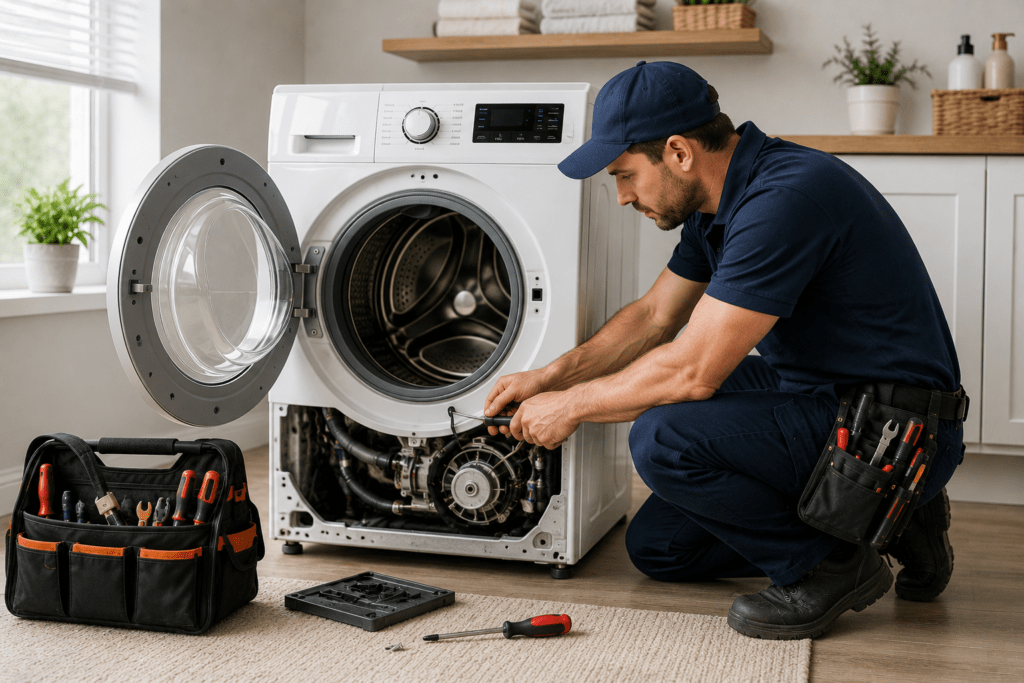
Attempting these repairs without proper training can result in additional damage or create electrical and safety hazards.
Tips to Reduce Washer Repair Costs
While no appliance lasts forever, regular maintenance can reduce wear and help prevent many common washer failures.
Don’t Overload the Washer
Overloading places additional strain on the motor, suspension system, bearings, and drive components, increasing the likelihood of costly repairs.
Use the Correct Detergent
Using too much detergent—or the wrong type—can create excessive suds, reduce cleaning performance, and contribute to residue buildup inside the machine. High-efficiency (HE) washers should always use HE detergent.
Leave the Door Open After Washing
For front-load washers, leaving the door slightly open after each load allows moisture to evaporate, helping reduce mold, mildew, and unpleasant odors around the door gasket.
Inspect Water Supply Hoses
Rubber hoses can crack or weaken over time. Inspect them periodically for signs of wear and replace damaged hoses before they fail and cause water damage.
Clean the Drain Pump Filter
Many washers include a removable filter that traps lint, hair, and small objects. Cleaning it according to the manufacturer’s recommendations can improve drainage and help prevent pump failures.
Keep the Washer Level
An unlevel washer can vibrate excessively during the spin cycle, placing unnecessary stress on suspension components and internal parts.
Address Problems Early
Ignoring unusual noises, leaks, or longer cycle times often allows minor issues to become major repairs. Prompt attention can reduce repair costs and extend the life of your appliance.
Frequently Asked Questions
How much does it cost to repair a washing machine?
Most homeowners spend between $140 and $450 for washer repairs. Minor repairs, such as replacing a lid switch or water inlet valve, typically cost much less than major repairs involving the transmission or electronic control board.
Is it worth repairing a 10-year-old washing machine?
Usually, yes—provided the repair costs less than half the price of a comparable new washer and the appliance has otherwise been reliable. If multiple major components have failed, replacement may be the better long-term investment.
What is the most expensive washing machine repair?
Transmission replacement is often the most expensive repair, with costs ranging from $450 to $800 or more depending on the model. Electronic control board replacement and drum bearing repairs can also be costly.
How long should a washing machine last?
Most washing machines last 10 to 14 years with proper maintenance. Regular cleaning, avoiding overloaded loads, and addressing small problems early can help extend the appliance’s lifespan.
Can I repair my washing machine myself?
Homeowners can safely perform basic maintenance such as cleaning the drain pump filter, replacing water supply hoses, and leveling the washer. More complex repairs involving electrical components, motors, pumps, or transmissions should generally be performed by a qualified appliance repair technician.
Related Appliance Repair Cost Guides
If you’re comparing repair costs throughout your home, these guides may also help:
Need Help With Your Appliance?
Get a guided diagnosis before scheduling a repair.
Or call 1-833-422-6740 for professional repair.