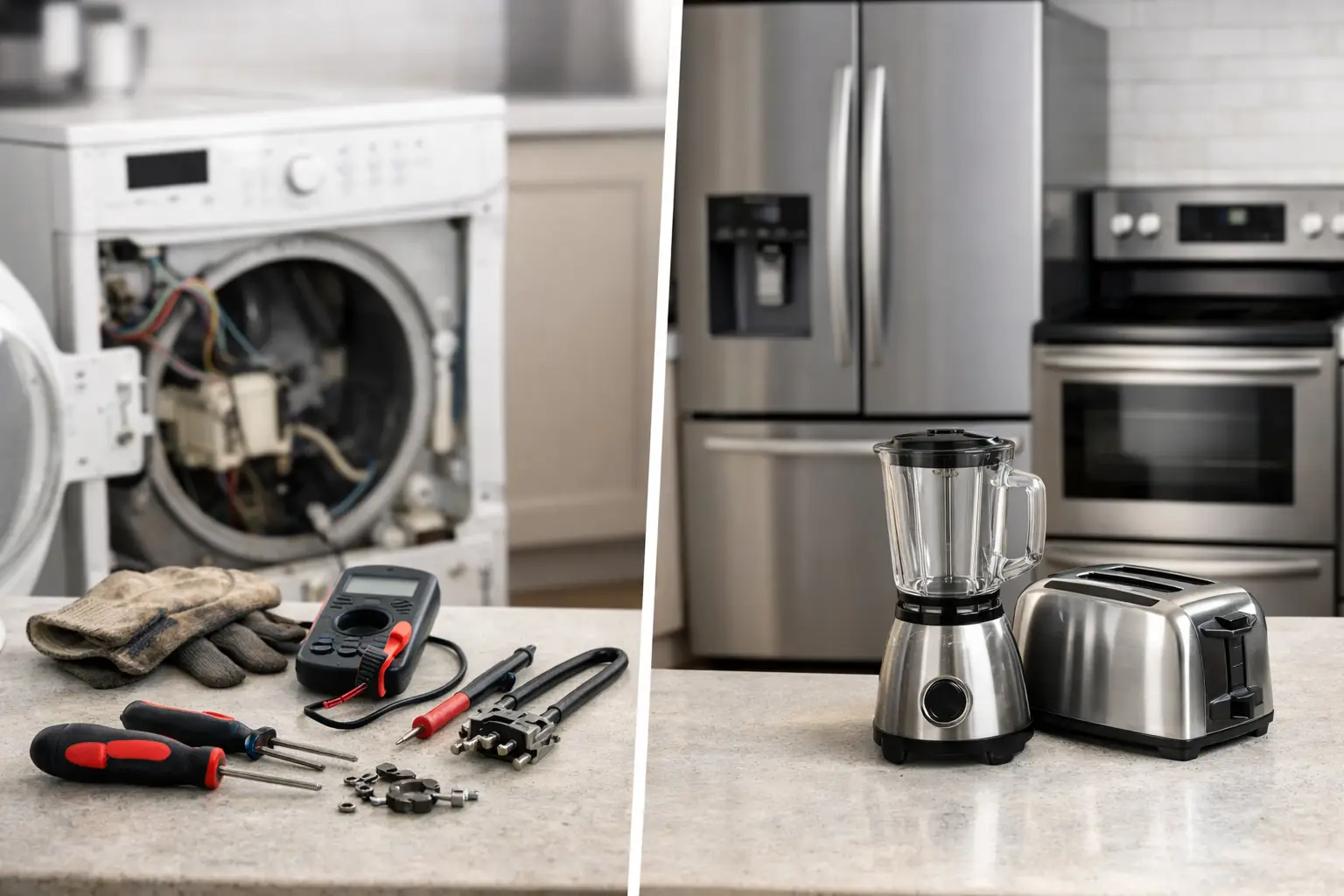
Your refrigerator is warm, the washer stopped mid-cycle, or the dryer is running without heat. The question becomes urgent fast: should I repair appliances, or is it time to replace them? The right answer is rarely just “repair” or “replace.” It depends on the appliance’s age, the type of failure, the expected repair cost, and how much disruption your household can handle.
A professional diagnosis can turn a stressful guess into a clear decision. Many common problems – a failed drain pump, worn door seal, bad heating element, or faulty ignition part – can be repaired for far less than the cost of a new appliance. Other failures, especially on older units with major sealed-system, motor, or control-board issues, may point toward replacement instead.
Deciding whether to repair or replace an appliance is a money decision — the free guided diagnosis helps you weigh a repair honestly, screens for danger first, and tells you when calling a professional is the smarter move. Get a repair-vs-replace recommendation →
Should I Repair Appliances? Start With the Repair-to-Replace Math
A practical rule is to compare the repair estimate with the price of a comparable new appliance. If the repair is less than about half the replacement cost and the appliance is not near the end of its expected life, repair is often the better value. For appliance-specific price benchmarks, review our washer repair cost and refrigerator repair cost guides.
For example, a $180 dishwasher pump repair can make sense when a comparable new dishwasher costs $700 to $1,000 and the current machine is only five years old. A $650 repair for a 14-year-old refrigerator may be harder to justify, particularly if the repair involves the compressor or sealed refrigeration system.
This rule is a starting point, not a guarantee. A premium appliance may be worth repairing at a higher percentage of its replacement price because comparable new models cost more. On the other hand, a lower-cost appliance with repeated failures can become expensive to keep alive, even if each individual repair seems manageable.
Ask the technician for a written estimate that separates the service call, labor, and parts. It also helps to ask whether the repair addresses the root cause or only restores operation temporarily. Clear cost information gives you the peace of mind to decide without rushing into a purchase you may regret.
Consider the Appliance’s Age and Expected Service Life
Age matters because parts wear over time, and older appliances can develop a series of unrelated issues. Still, age alone does not mean replacement is necessary. A well-maintained appliance with one isolated failure can have years of useful service left.
Typical lifespans vary by brand, model, usage, and maintenance. Refrigerators often last 10 to 15 years. Dishwashers commonly provide around 9 to 12 years of service. Washing machines and dryers may last roughly 10 to 13 years, while ovens and cooktops can last longer because they have fewer moving parts. Microwaves tend to have shorter service lives, often around 7 to 10 years.
If an appliance is in the first half of its expected life, repair is usually worth serious consideration. If it is at or beyond its expected lifespan, weigh the repair estimate more carefully. A repair can still be sensible when you need a short-term solution or when the issue is minor, but it may not be the best long-term investment.
Failures That Often Make Repair Worthwhile
Many appliance problems are routine and repairable. A dishwasher that will not drain may need a pump, hose clearing, or drain component. A dryer that tumbles but does not heat may have a failed heating element, thermostat, thermal fuse, or igniter. A washing machine that will not spin may have a lid switch, belt, coupling, or drain-pump issue.
Refrigerator repairs can also be worthwhile when the problem is a fan motor, defrost component, ice maker part, water inlet valve, or door gasket. On ranges and ovens, failed igniters, burners, bake elements, temperature sensors, and switches are often repairable without replacing the entire appliance.
These are not DIY diagnoses. Electrical components, gas connections, sharp panels, and refrigerant systems create real safety concerns. A certified appliance technician can identify the failed part, check for related damage, and help get the job done right the first time.
Failures That May Favor Replacement
Replacement becomes more appealing when the repair involves a major component on an aging machine. Examples include a refrigerator compressor or sealed-system failure, a washer transmission or tub bearing problem, or extensive control-board damage after an electrical surge.
Parts availability matters too. If a manufacturer no longer makes a critical part, a repair may be delayed, costly, or impossible. Repeated breakdowns are another warning sign. Two repairs over several years may be normal ownership. Multiple service calls in a few months can mean the appliance is becoming unreliable.
There is also the question of safety. Replace rather than postpone action if an appliance has burned wiring, a persistent gas smell, sparking, smoke, significant water leakage near electrical connections, or a damaged door latch that affects safe operation. Turn off power or gas when appropriate and arrange qualified service promptly.
Not sure if a repair is worth it for your situation? Run the free decision check — it walks you through what to consider and gives you an honest read on repair versus replacement. Run the free decision check →
Factor in Efficiency, Features, and Installation Costs
New appliances can offer better energy or water efficiency, quieter operation, and useful features. That benefit is real, but it should not be overstated. Replacing a functioning appliance solely for modest utility savings can take years to pay off.
A newer refrigerator may use less electricity than an older model, while a modern dishwasher may use less water and run more quietly. But replacement also brings costs beyond the sticker price: delivery, installation, haul-away, possible plumbing or electrical updates, and sales tax. If you need a new unit immediately, limited inventory can also narrow your choices.
Before replacing a built-in dishwasher, wall oven, cooktop, or over-the-range microwave, confirm dimensions and installation requirements. A unit that looks like a straightforward replacement can require cabinet changes, venting work, or electrical modifications. Repairing the existing appliance may be the faster, less disruptive option.
Think About Urgency Without Letting It Force a Bad Decision
A broken refrigerator, freezer, washer, or oven can interrupt the whole household. That urgency can make a new purchase feel like the only answer. Often, fast repair is the better path, especially when the needed part is commonly available and the appliance is otherwise in good condition.
Protect food safety first if a refrigerator or freezer is not holding temperature. Move perishables to a cooler or another working refrigerator when possible, and avoid repeatedly opening the doors. For a leaking washer or dishwasher, shut off the water supply if you can do so safely. If a dryer smells hot or a range has a gas odor, stop using it and address the issue right away.
A dependable local technician can help you understand whether same-day or prompt repair is realistic. US Appliance Repairs helps homeowners connect with independent local appliance repair providers, reducing the time spent searching when an essential machine is down.
Questions to Ask Before You Approve a Repair
You do not need to become an appliance expert to make a smart decision. During the service visit, ask a few direct questions: What failed? Is this a common repair for this model? Is there evidence of another major issue? How long should this repair reasonably extend the appliance’s life? And if replacement is the better choice, what makes it the better value?
Also ask about parts and labor coverage offered by the independent repair provider. A quality repair recommendation should be specific to your appliance, not a one-size-fits-all sales pitch. The goal is reliable operation, a fair cost, and fewer surprises after the technician leaves.
Before you approve any repair, run the free decision check — it screens for danger first, then helps you compare the repair against replacement with safety and cost in mind. Start the free repair-vs-replace check →
When a Small Repair Prevents a Big Expense
Maintenance can change the repair-versus-replace equation. Cleaning refrigerator coils when accessible, clearing dryer venting, checking washer hoses, cleaning dishwasher filters, and avoiding overloaded machines can reduce strain on important components. These small habits do not prevent every failure, but they can help an appliance run more efficiently and last longer.
If your appliance has stopped working, do not assume it belongs at the curb. Get a clear diagnosis, compare the repair with the true cost of replacement, and choose the option that restores reliability without creating unnecessary expense. A timely repair may be exactly what gets your home back up and running.