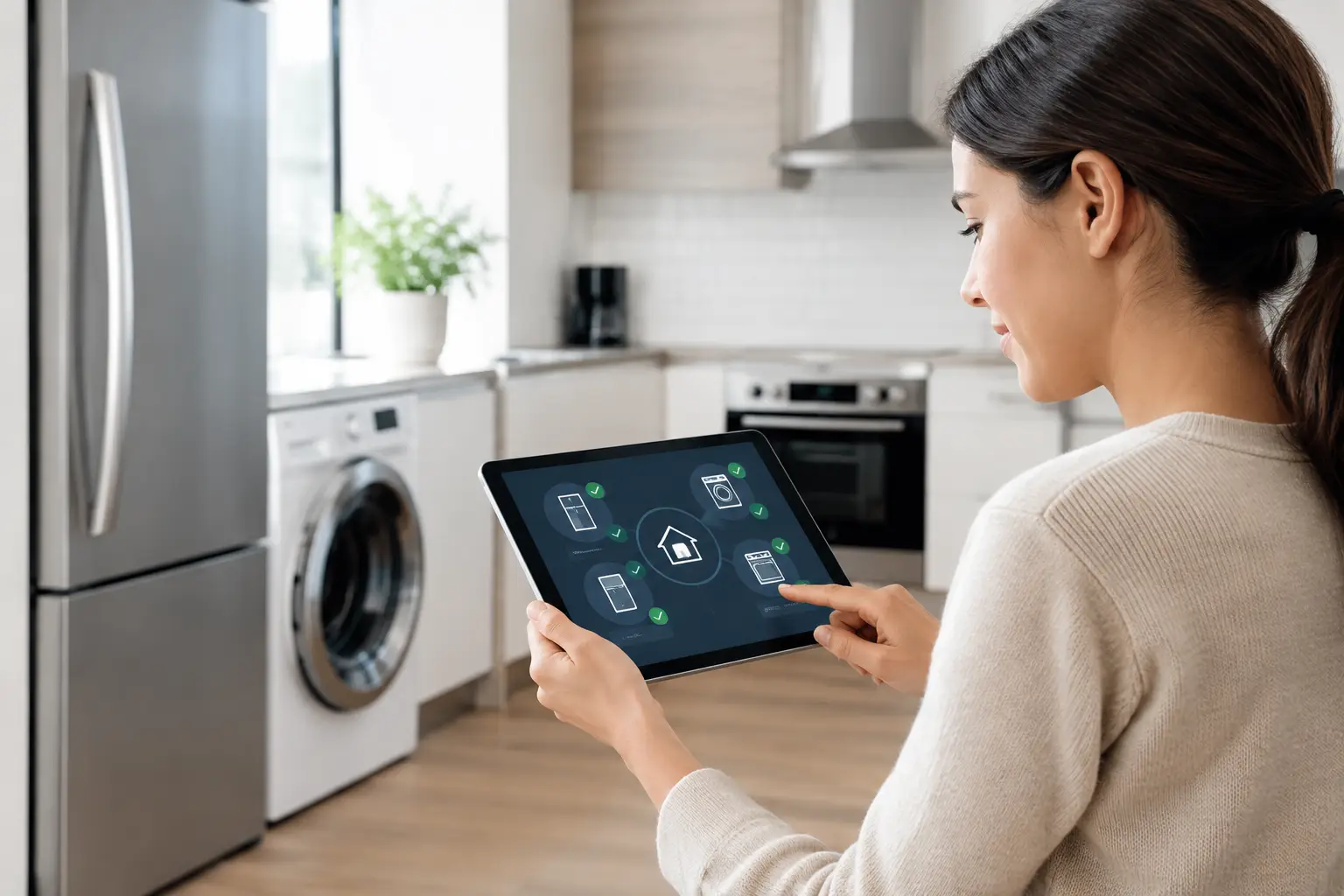
A refrigerator that sends an alert before food starts warming up. A washer that identifies an unbalanced drum before it damages the suspension. A dryer that reports restricted airflow before overheating becomes a bigger problem. Future home appliance diagnostics are moving closer to that reality, giving homeowners earlier warnings and better clues about what may be wrong.
That does not mean every appliance message will come with a simple fix. Smart diagnostics can reduce guesswork, but a warning code is not the same as a confirmed repair diagnosis. For homeowners, the real value is knowing when a small issue can wait, when basic troubleshooting is appropriate, and when it is time to get fast help from a qualified appliance repair professional.
Not Sure You Need a Repair?
Before you pay for a service call, try FixDecision AI. Describe what's wrong with your appliance and get a safety-first assessment to help you decide whether to DIY or call a professional.
How Future Home Appliance Diagnostics Will Work
Many newer appliances already monitor their own operation. They track water temperature, motor speed, compressor run time, airflow, door position, electrical performance, and other signals that affect daily operation. When readings fall outside an expected range, the appliance may display an error code, flash a warning light, or send an alert through a manufacturer app.
The next generation will use those signals more actively. Instead of only reporting that a dishwasher has stopped mid-cycle, it may identify whether the likely cause is a drain restriction, a failing circulation pump, a door latch problem, or an electronic control issue. A connected refrigerator may notice that the compressor is running longer than usual and recommend checking door seals, cleaning the condenser area, or scheduling service before cooling performance drops.
This is often called predictive maintenance. Rather than waiting for a complete breakdown, the appliance looks for patterns that suggest a component is wearing out or operating under strain. It can be especially useful for appliances that tend to fail gradually, including refrigerators, dryers, washers, and dishwashers.
Earlier Warnings Can Prevent Bigger Problems
The strongest benefit of advanced diagnostics is not convenience alone. It is the chance to act before a manageable repair turns into an expensive household disruption.
A dryer with poor airflow may continue heating, but restricted venting can lengthen dry times, waste energy, and create a safety concern. A diagnostic alert may tell the homeowner to inspect the lint screen and exterior vent before the dryer begins overheating or stops heating altogether. Likewise, a washing machine that repeatedly struggles to balance a load may be signaling worn suspension parts, leveling issues, or a problem with the basket assembly.
For refrigerators and freezers, early warnings can matter even more. A minor temperature change may be caused by a door left slightly open, frost buildup, a dirty condenser area, or a developing fan or sensor problem. Addressing the issue quickly can help protect groceries and may prevent the appliance from working harder than necessary.
There is a practical financial benefit, too. Service calls are often less stressful when homeowners can describe a specific warning, error code, change in performance, or repeating pattern. That information helps a technician arrive better prepared and can shorten the path to an accurate diagnosis.
What Smart Diagnostics Can and Cannot Tell You
A connected appliance can collect useful data, but it cannot physically inspect a cracked hose, hear every unusual sound accurately, or determine whether a poor installation is contributing to the failure. It also cannot always distinguish between a failed part and a wiring, control-board, or power-supply issue that creates similar symptoms.
For example, a dishwasher may report a draining problem. The actual cause could be a clogged filter, a blocked air gap, a kinked drain hose, a failing drain pump, or a problem at the kitchen sink drain connection. The alert is useful because it narrows the possibilities. It does not replace hands-on testing.
Error codes can also be misleading when they are read in isolation. One code may point to a sensor, but the sensor may be responding correctly to another underlying problem. Replacing parts based only on an app notification can waste money and leave the original issue unresolved.
That is why future diagnostics should be treated as an early-warning system, not a do-it-yourself repair order. If an appliance is leaking, smoking, tripping a breaker, producing a burning smell, failing to cool, or making loud mechanical noises, turn it off when safe to do so and arrange professional service promptly.
The New Role of the Appliance Repair Technician
As appliances become more connected, repair technicians will rely on both digital information and traditional diagnostic skills. They may review stored fault history, operating data, and manufacturer test modes before checking components with professional tools. That can make troubleshooting faster, but the repair still depends on experience.
A qualified technician knows how to verify whether a displayed code matches the actual failure. They can inspect wiring, test voltage, check seals and moving parts, evaluate airflow or water flow, and confirm that a replacement part solves the problem. That final verification matters. A machine may appear to work for one cycle after a reset, then fail again if the real cause was not corrected.
Remote diagnostic features may also change how appointments are planned. In some cases, a homeowner can provide the model number, error code, and app report before service is scheduled. The repair provider may then have a better idea of which parts or tools could be needed. It will not eliminate every return visit, especially for uncommon models or complex failures, but it can improve preparation and reduce downtime.
Privacy, Compatibility, and Other Trade-Offs
More connected features are not automatically better for every household. Smart appliances may require a reliable Wi-Fi connection, account setup, software updates, and permission to share certain operating data. Homeowners should review privacy settings and understand what information is being collected and who can access it.
Compatibility can be another issue. An appliance app may work best with a particular phone, home network, or manufacturer ecosystem. Older appliances will not gain these features simply because a new app becomes available. In many cases, a well-maintained conventional appliance remains a dependable and cost-effective choice.
There is also the question of repairability. More sensors and electronics can provide better alerts, but they can add complexity when something fails. A basic mechanical problem may still be straightforward, while a control-board or communication issue may require more specialized testing. Whether repair makes sense depends on the appliance age, condition, repair cost, expected remaining life, and the availability of parts.
What Homeowners Should Do When an Alert Appears
Start by reading the full message, not just the code. Note the appliance model, the date and time of the alert, any unusual sounds or smells, and whether the machine completed its last cycle. If the manufacturer provides safe homeowner checks, such as cleaning a filter or confirming that a door is fully closed, follow those instructions.
Avoid repeatedly resetting the appliance to make a warning disappear. A reset may clear the display temporarily while the original condition remains. It can also make it harder for a technician to see stored error information.
For water leaks, electrical concerns, gas odors, burning smells, or loss of refrigerator or freezer cooling, do not wait for another notification. Protect the home first, then seek prompt repair help. For less urgent warnings, scheduling service before the appliance fails completely can still save time, food, laundry, and frustration.
Better Information, Faster Repair Decisions
The future of appliance service is likely to be more informed, not fully automated. Homeowners will have clearer warnings. Technicians will have more data. Yet the best outcome will still come from matching the technology with sound judgment and a repair professional who can confirm the cause and do the job right the first time.
When a smart alert becomes a real appliance problem, keep the code and model number handy, describe what changed, and get reliable help before a small warning turns into a broken appliance at the worst possible time.