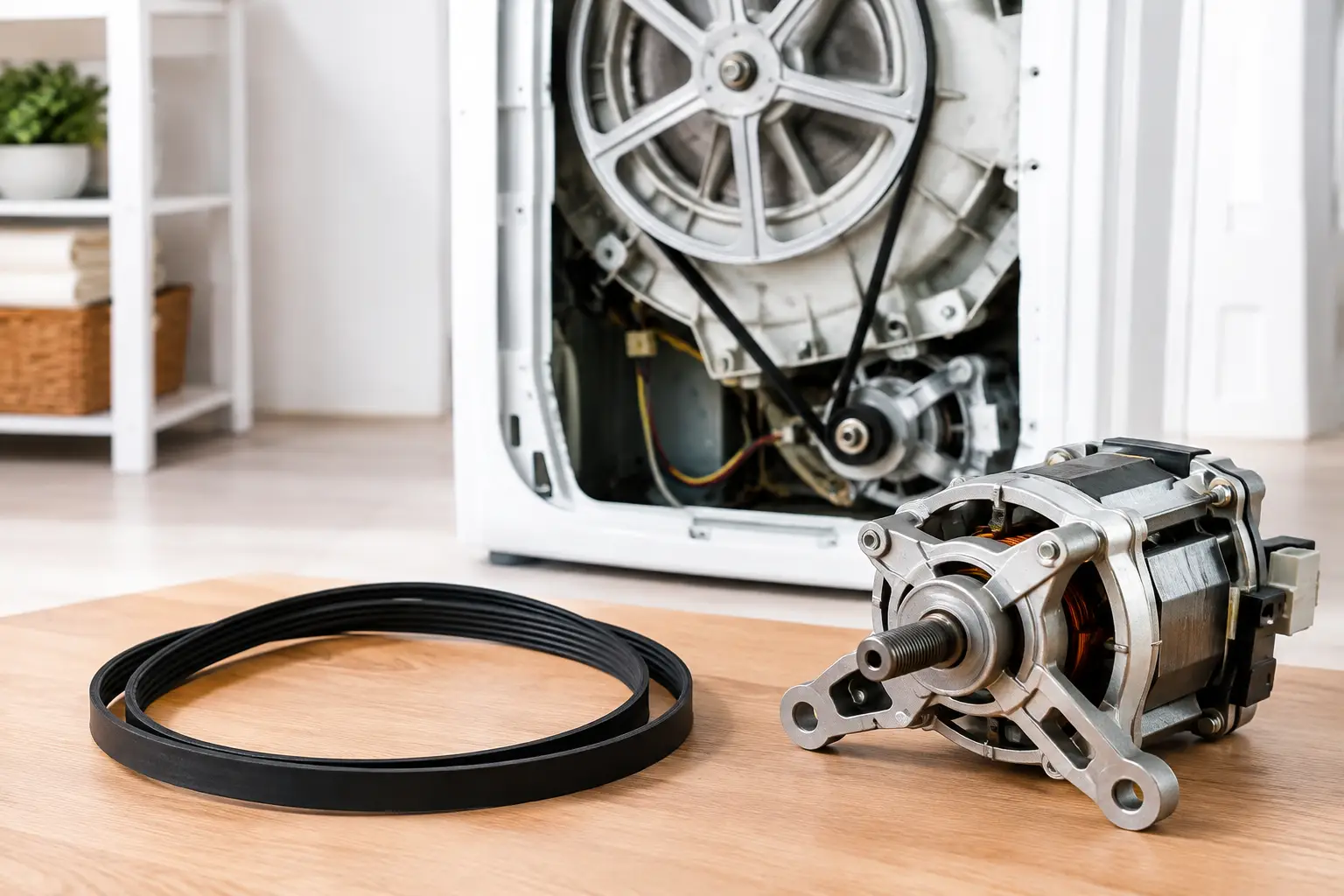
A washer that fills with water but will not spin can turn laundry day into a stressful mess fast. Washer belt versus motor failure is one of the most common questions behind that symptom, especially on older belt-driven machines. Both problems can leave clothes soaking wet, but the sound, smell, and movement of the washer often point in different directions.
The good news is that a worn belt is usually a more straightforward repair than a failed motor. The catch is that many current washing machines do not use a traditional drive belt at all. They may use a direct-drive motor, a stator and rotor system, or an electronic motor control. Knowing what type of washer you own helps prevent guesswork and helps a repair technician get the appliance back up and running without unnecessary delays.
Not Sure You Need a Repair?
Before you pay for a service call, try FixDecision AI. Describe what's wrong with your appliance and get a safety-first assessment to help you decide whether to DIY or call a professional.
Washer Belt Versus Motor Failure: The Key Differences
A drive belt transfers power from the motor to the transmission or pulley that turns the basket. On a belt-driven washer, the motor can still run normally while the belt slips, stretches, cracks, or breaks. When that happens, you may hear the motor humming or running, but the basket does not agitate or spin as it should.
A motor failure is different. The motor itself may not start, may cut out during a cycle, or may make an electrical humming sound without turning. Depending on the washer design, the real source may also be a worn motor coupler, faulty wiring, a failed capacitor, a lid switch problem, or an electronic control issue. That is why a professional diagnosis matters before approving a major repair.
The age of the washer also changes the odds. Older top-load washers are more likely to have accessible belts and mechanical components. Many newer front-load and high-efficiency models rely on direct-drive systems or sophisticated electronics, so a loose or broken belt is less likely, though not impossible.
Signs Your Washer May Have a Bad Belt
A failing washer belt often creates a gradual problem rather than a sudden total shutdown. The machine may begin struggling during the spin cycle, leaving laundry wetter than usual. You may also notice a squealing, squeaking, slapping, or rubbery burning smell as the belt slips against a pulley.
If the washer fills and you can hear the motor running, but the tub barely moves or does not move at all, the belt is a reasonable suspect on a belt-driven model. A belt can become glazed and slick with age, develop cracks, or stretch enough that it no longer grips correctly. An overloaded washer can speed up that wear, particularly if bulky items regularly make the machine strain.
A broken belt may produce a sudden stop in agitation or spinning. The washer may sound normal from the outside because the motor is still operating, yet the drum remains still. In some cases, the belt can come off a pulley because another part, such as a seized bearing or damaged pulley, created excess resistance. Replacing only the belt without finding that underlying issue can lead to another failure soon after.
Signs the Washer Motor May Be Failing
Motor trouble is often more noticeable during startup. You might press Start, hear a low hum or click, and see no drum movement. The washer may repeatedly attempt to begin a cycle and then stop, display an error code, or trip a circuit breaker. A hot electrical smell is more concerning than a rubber smell and should not be ignored.
Other warning signs include intermittent operation, a motor that works only after the washer cools down, or a machine that stops halfway through a heavy load. Some motors have thermal overload protection that shuts them off when they overheat. That overheating may come from the motor itself, but it can also be caused by a jammed pump, seized tub bearing, overloaded basket, or a control problem sending the wrong signal.
A completely silent washer is not automatically a motor failure. If nothing happens when the cycle should begin, a faulty lid lock, door switch, timer, control board, power connection, or wiring issue may be preventing the motor from receiving power. Modern washers often will not spin at all if the control cannot confirm that the lid or door is safely locked.
Safe Checks You Can Make Before Scheduling Service
Start with the simple checks that do not require opening the cabinet. Make sure the washer is plugged in, the breaker has not tripped, and the cycle selection is correct. If the washer has an error code, write it down exactly. That information can shorten the diagnostic process.
Next, remove a few heavy items if the load is packed tightly or badly unbalanced. A single comforter, bath mat, or pair of waterlogged shoes can prevent a washer from reaching full spin. Try a rinse-and-spin cycle with a smaller, balanced load. If the washer works normally afterward, the motor may be fine.
Listen carefully. A high-pitched squeal or smell of hot rubber points more toward a slipping belt on an applicable model. A repeated hum, clicking, electrical odor, or sudden shutdown points more toward a motor, start component, wiring, or control issue. These are clues, not a final diagnosis.
Do not remove panels or reach beneath the washer while it is plugged in. Washers contain moving parts, capacitors, and wiring that can create shock or injury risks. If you see smoke, smell burning insulation, or hear harsh grinding, unplug the appliance if it is safe to do so and stop using it until it has been inspected.
What Repair Costs Can Look Like
A washer belt replacement is commonly one of the lower-cost mechanical repairs because the part itself is relatively inexpensive. Total cost still depends on the model, how difficult the belt is to access, local labor rates, and whether a pulley, bearing, or other component also needs attention.
Motor-related repairs usually cost more. A motor replacement can involve labor-intensive disassembly, testing electrical components, and confirming that the motor was not damaged by another failing part. On electronically controlled washers, a technician may need to determine whether the motor, inverter board, harness, or main control is actually at fault. Replacing a motor without that testing can waste money.
For an older washer with multiple problems, compare the repair estimate with the machine’s age, condition, capacity, and expected remaining life. A simple belt repair is often worth doing. A costly motor repair on a washer that also has bearing noise, leaks, or repeated electronic errors may make replacement the more practical choice. There is no one answer for every household, but a clear diagnosis gives you a better decision.
When Fast Professional Help Makes Sense
Call for service when the washer will not spin after basic load balancing, when it makes a burning smell or grinding noise, or when it repeatedly shuts down. Fast help is especially useful if wet laundry is trapped inside, water is not draining, or the washer is leaking at the same time.
An experienced appliance technician can check belt condition, pulley alignment, motor resistance, wiring connections, lid or door lock operation, drain performance, and control-board signals. That step-by-step approach identifies whether you are dealing with a simple worn part or a larger mechanical or electrical repair. It also helps protect your peace of mind when a washer failure disrupts the household.
US Appliance Repairs can help homeowners connect with independent local repair providers when a washer needs prompt attention. Ask for the diagnosis and estimate in plain language, including whether any related part may have caused the failure.
A squealing washer may only need a belt, while a silent or overheating machine may need deeper electrical testing. Acting on the symptoms early can often keep a manageable repair from becoming a bigger interruption to your home.