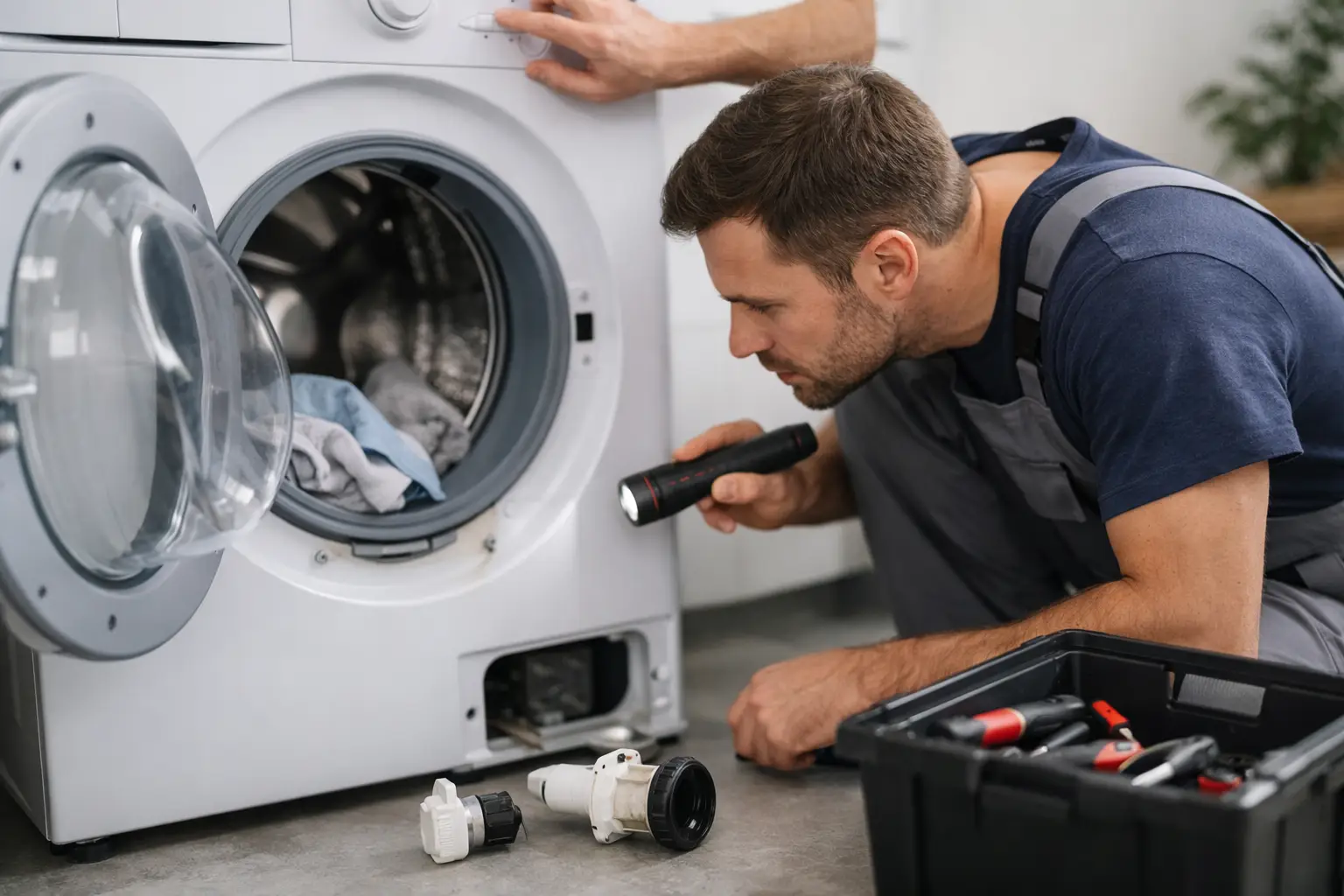
A washing machine won’t spin at the end of a cycle, and suddenly a normal load of laundry becomes a heavy, dripping mess. Before you wring everything out by hand or assume the washer is finished, check a few simple causes. Some are safe to handle at home. Others involve electrical parts, motors, or a failed drain system and need fast help from a qualified appliance technician.
Not Sure You Need a Repair?
Before you pay for a service call, try FixDecision AI. Describe what's wrong with your appliance and get a safety-first assessment to help you decide whether to DIY or call a professional.
Start With the Load and the Washer Door
Modern washers are designed not to spin when conditions are unsafe. An overloaded tub, a single heavy item, or an unlatched lid can stop the spin cycle even though the washer filled and agitated normally.
First, pause the cycle and unplug the machine. Open the lid or door and redistribute the laundry. A bulky comforter, bath mat, or one pair of jeans can throw the basket off balance, especially in a large top-load washer. Remove a few items if the tub is packed tightly, then restart the spin or drain-and-spin setting.
For a front-load washer, make sure the door closes firmly and nothing is caught in the seal. For a top-load model, check that the lid closes completely. If the washer starts but stops as it reaches spin, or it will not begin spinning at all, a worn lid switch or door-lock assembly may be the issue. The machine cannot safely spin at high speed unless it receives confirmation that the lid or door is secured.
If the Washing Machine Won’t Spin, Check for Drainage Trouble
A washer usually will not spin if it cannot drain the water first. If clothes are soaking wet and there is standing water in the tub, the problem may be drainage rather than the spin system itself.
Look at the drain hose behind the washer. It should not be kinked, crushed against the wall, or pushed too far down into the standpipe. A blocked or improperly installed hose can prevent water from leaving the machine. If you can safely move the washer, inspect the hose for visible bends or damage.
Front-load washers often have a drain-pump filter that collects lint, coins, buttons, hair ties, and small items left in pockets. The filter location varies by model, but it is commonly behind a small access panel near the bottom front of the machine. Check the owner’s manual before opening it, place towels and a shallow pan nearby, and expect water to spill out.
Do not keep restarting a washer that is full of water. Repeated attempts can strain the drain pump and may cause an overflow. A humming noise with no drainage, a burning smell, or water leaking onto the floor are good reasons to stop using the appliance and schedule service.
Common Reasons a Washer Will Not Spin
Once an uneven load and obvious drain-hose issue are ruled out, the cause is often a worn or failed component. The exact diagnosis depends on whether you have a top-load, front-load, belt-driven, or direct-drive washer.
Failed lid switch or door lock
A defective lid switch or door lock is one of the most common reasons a washer will not enter the spin cycle. You may hear a click when the lid closes but get no spin, or the control panel may show a door-lock error. This repair is usually straightforward for a technician, but the part must match the washer model and be installed correctly.
Drain pump blockage or failure
The drain pump removes water before spinning begins. A small object may jam its impeller, or the pump motor may wear out over time. Symptoms can include a buzzing or grinding sound, slow drainage, or a washer that stops with water still inside.
Worn drive belt, clutch, or motor coupling
Some washers use a belt to turn the basket. If that belt is loose, cracked, or broken, the washer may agitate but fail to spin properly. Older top-load machines may also have a worn clutch or motor coupling. These parts can produce squealing, thumping, or a basket that turns slowly instead of reaching full spin speed.
Faulty suspension, shocks, or bearings
A washer that bangs violently, walks across the floor, or repeatedly stops to rebalance may have worn suspension rods, shock absorbers, or tub bearings. Leveling the machine can help if the floor is uneven, but persistent shaking points to a mechanical issue. Continuing to run the washer can damage the tub, cabinet, or internal connections.
Motor, control board, or sensor problem
If the washer powers on but does not respond correctly to a spin command, a failed motor, speed sensor, wiring connection, or electronic control board could be responsible. These failures require testing with the proper tools. Replacing parts based on a guess can turn a manageable repair into an expensive one.
Safe Checks You Can Make Before Calling for Repair
A few homeowner checks can save time and help explain the problem clearly when you schedule service. Always unplug the washer before inspecting anything beyond the control panel, lid, door, or drain hose.
- Run a small, balanced test load on the drain-and-spin setting after redistributing the laundry.
- Confirm the washer is level and all four feet are firmly on the floor.
- Check the drain hose for kinks and make sure the wall drain is not visibly backing up.
- Clean the accessible drain-pump filter if your owner’s manual identifies one and you can do so safely.
- Note any error code, unusual noise, burning odor, water leak, or point in the cycle where the washer stops.
Avoid bypassing a lid switch or door lock. These are safety devices, not inconveniences. Also avoid tipping a heavy washer, removing major panels, or reaching into the pump area while the appliance is connected to power. Water and electrical components are a risky combination.
What Does It Cost to Fix a Washer That Won’t Spin?
Repair costs vary by washer type, part availability, location, and the underlying failure. A simple service call for a blocked drain filter, kinked hose, or minor adjustment may cost less than a major mechanical repair. Replacing a lid switch, door lock, drain pump, belt, or suspension component is often a practical repair when the washer is otherwise in good condition.
Motor, control board, transmission, and bearing repairs can cost more because the parts and labor are more involved. For many homeowners, the best decision depends on the washer’s age and original quality. A repair that makes sense on a five-year-old, higher-end machine may not be worthwhile for a basic washer that is nearing the end of its expected service life.
As a general rule, consider replacement when a major repair approaches half the price of a comparable new washer, particularly if the machine has had repeated problems. A technician can identify the failed part, provide a clearer estimate, and help you weigh the repair-versus-replacement decision without guesswork.
When to Get Fast Professional Help
Call for washer repair promptly if the machine has standing water, leaks, smoke, a burning smell, loud metal-on-metal noises, or an electrical error that returns after a reset. These signs can lead to floor damage, damaged laundry, or a larger appliance failure if the washer keeps running.
For less urgent problems, service is still worthwhile when basic checks have not restored the spin cycle. A qualified local technician can test the door lock, pump, motor, belt system, sensors, and controls without replacing parts unnecessarily. US Appliance Repairs can help homeowners connect with independent local repair providers when they need reliable help getting the laundry routine back up and running.
Wet laundry is frustrating, but it does not automatically mean you need a new washer. Start with the load, lid or door, and drainage path. If the machine still will not spin, stop forcing cycles and get a clear diagnosis so the repair is done right the first time.