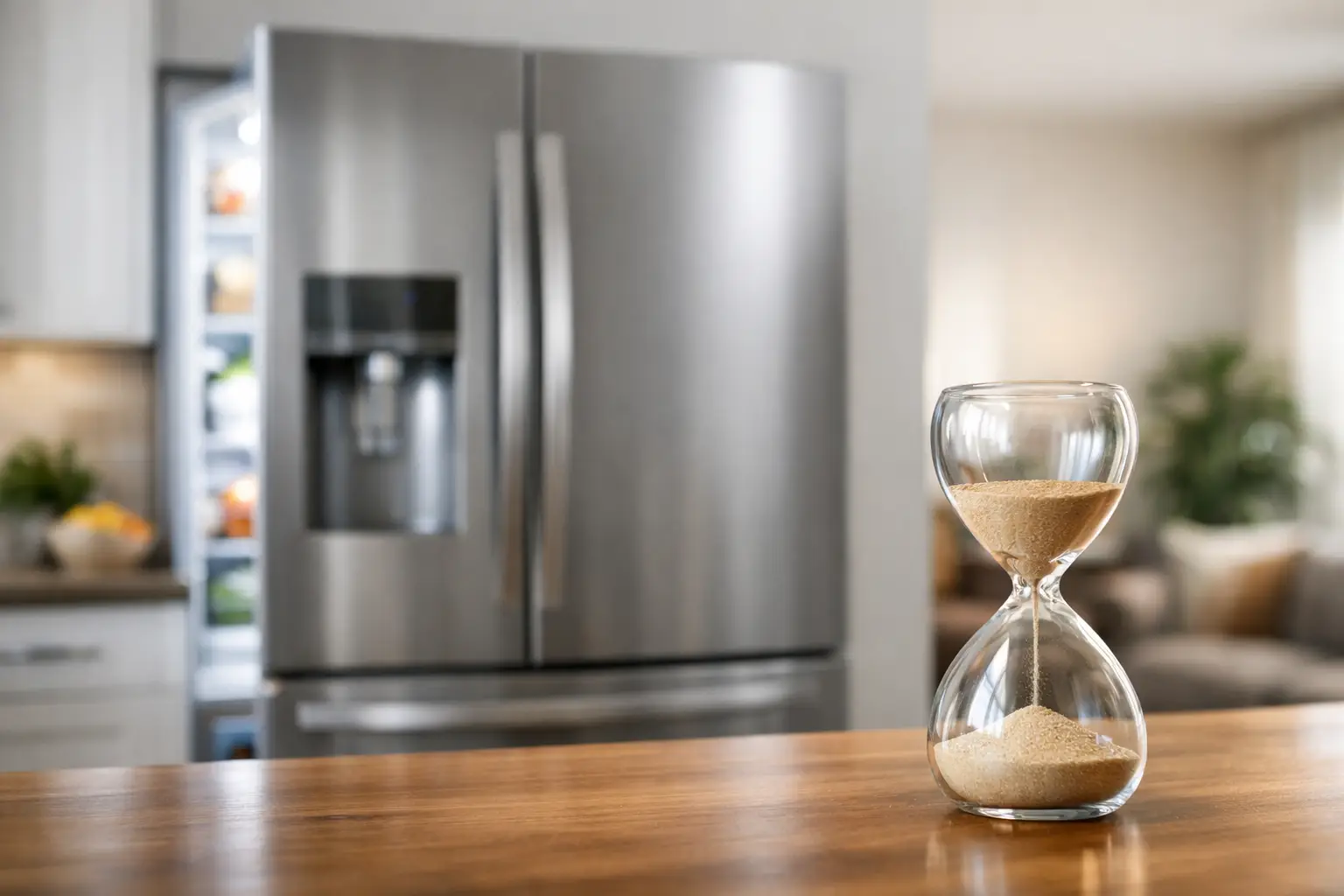
A refrigerator that suddenly stops cooling can turn a normal afternoon into a race to save groceries. Knowing the average refrigerator lifespan helps you make a calmer decision: is this an affordable repair, a maintenance issue, or a sign that replacement makes more sense?
For most homeowners, a refrigerator lasts long enough that its eventual breakdown comes as a surprise. The answer is not one fixed number, though. Brand, configuration, maintenance, usage, and the type of failure all affect how long your fridge remains dependable.
What Is the Average Refrigerator Lifespan?
The average refrigerator lifespan is usually 10 to 15 years. Many standard top-freezer models can reach 15 years or more with regular care, while some feature-heavy models may need major repairs sooner. A well-maintained refrigerator can occasionally last close to 20 years, but homeowners should view that as a bonus rather than an expectation.
Refrigerators work around the clock, unlike many other household appliances. Their compressors, fans, control boards, defrost systems, door seals, and ice makers all experience steady wear. As the appliance ages, one small failure may be easy to fix, but several failures arriving close together can make replacement the more practical choice.
The model style can also make a difference. Simple top-freezer refrigerators often have fewer components and may be less expensive to repair. Side-by-side, French-door, and built-in units offer useful storage and convenience, but their ice makers, water dispensers, electronic controls, and multiple cooling zones can add repair complexity. That does not mean a feature-rich refrigerator will fail early. It means the repair decision deserves a closer look when it does.
What Affects How Long a Refrigerator Lasts?
Age is only part of the picture. A refrigerator in a busy household may be opened dozens of times a day, while one in a lightly used second home runs under a different level of demand. Location matters too. A fridge squeezed into a hot garage or placed tight against a wall may have to work harder to release heat.
Dirty condenser coils are a common, preventable issue. When dust, pet hair, and debris collect on the coils, the refrigerator cannot cool as efficiently. The compressor may run longer, energy use may rise, and the added strain can shorten the life of important components.
Poor door seals also make the refrigerator work harder. If warm kitchen air leaks in around a worn gasket, the unit may run frequently, develop frost, or struggle to maintain a safe temperature. Overloading the refrigerator can restrict airflow as well, while an almost empty fridge may lose cold air quickly whenever the door opens. Neither issue is usually an emergency by itself, but both can contribute to uneven cooling.
Power problems deserve attention, especially in areas with frequent outages or electrical surges. A surge can damage an electronic control board, and repeated power interruptions can be hard on a compressor. If the refrigerator shares a circuit with high-demand appliances or lights dim when it starts, a qualified professional can help identify whether an electrical issue is involved.
Warning Signs Your Refrigerator Is Nearing the End
Not every strange sound means the refrigerator is done. A fan motor, evaporator issue, defrost component, or worn door gasket can often be repaired. Still, certain patterns suggest an aging unit may be becoming less reliable.
Food that freezes in the fresh-food section, milk that spoils too quickly, or temperatures that swing from one day to the next are signs worth taking seriously. So are frequent cycling, excess frost, water pooling beneath the unit, and a motor that seems to run almost constantly. A loud clicking sound can point to a start relay or compressor concern, while buzzing, rattling, or grinding may come from a fan or other moving part.
Ice maker trouble is frustrating but should be judged separately from overall cooling performance. A refrigerator that cools properly but has a failed ice maker may still be a good repair candidate. On the other hand, a unit with an ice maker issue, recurring leaks, inconsistent temperatures, and a failing control panel may be telling a different story.
If your refrigerator is warm inside, move perishable food to a cooler with ice or another working refrigerator as quickly as possible. Avoid repeatedly opening the doors while deciding what to do. Fast action can reduce food loss and give you more peace of mind while arranging service.
Repair or Replace? Use the Age and Cost Together
A refrigerator under about eight years old is often worth repairing, assuming it has not had repeated major problems. Repairs such as a thermostat, fan motor, defrost heater, door gasket, water inlet valve, or ice maker component can restore dependable operation without the cost and disruption of buying a new appliance.
Between eight and 12 years, the decision depends more heavily on the diagnosis and repair estimate. A one-time repair may still be sensible, especially for a quality model that has otherwise been reliable. However, if the repair cost is approaching half the price of a comparable replacement refrigerator, many homeowners choose to put that money toward a newer unit with a fresh warranty.
Once a refrigerator is more than 12 to 15 years old, replacement becomes more appealing when the compressor, sealed system, or multiple electronic parts fail. Compressor and sealed-system work can be expensive, and an older refrigerator may soon need another repair after the first one is completed. A certified technician can identify the failed part and help you understand whether the repair is likely to provide lasting value.
There are exceptions. Built-in and premium refrigerators cost much more to replace than standard freestanding models, so a substantial repair can still be worthwhile. Conversely, a basic older fridge with poor efficiency and recurring problems may not justify even a modest repair. The right decision is based on the appliance’s age, repair history, condition, replacement cost, and the urgency of getting your kitchen back up and running.
Extending Your Refrigerator’s Lifespan
A few routine habits can help your refrigerator run with less strain. Clean accessible condenser coils about once or twice a year, following the manufacturer’s safety instructions and unplugging the unit first. Keep adequate space around the refrigerator for ventilation, particularly behind and above it where recommended.
Check the door gaskets periodically for cracks, looseness, or food residue. A simple paper test can be helpful: close the door on a strip of paper and gently pull. If it slides out with little resistance in several places, the seal may need cleaning, adjustment, or replacement.
Set the refrigerator compartment close to 37 to 40 degrees Fahrenheit and the freezer at 0 degrees Fahrenheit. An inexpensive appliance thermometer can be more reliable than trusting the control dial alone. Avoid blocking interior vents with large containers, and address dripping water, excessive frost, or unusual sounds before they become a larger failure.
When to Call for Refrigerator Repair Help
Call for service promptly if the refrigerator is not cooling, the freezer is thawing, the unit is leaking, or you smell burning or notice an electrical odor. These are not problems to wait out. A technician can determine whether the cause is a replaceable component, an airflow issue, a defrost failure, or a more serious compressor or sealed-system problem.
For less urgent concerns, such as an intermittent noise or a weak ice maker, scheduling an evaluation early can still prevent a full breakdown at an inconvenient time. US Appliance Repairs can help homeowners connect with independent local appliance repair providers, reducing the hassle of searching for help when an essential appliance is already causing stress.
A refrigerator does not have to be brand-new to be dependable. When you know its age, watch for changes in cooling performance, and get a clear diagnosis before spending money, you can make a practical choice that protects your food, budget, and household routine.