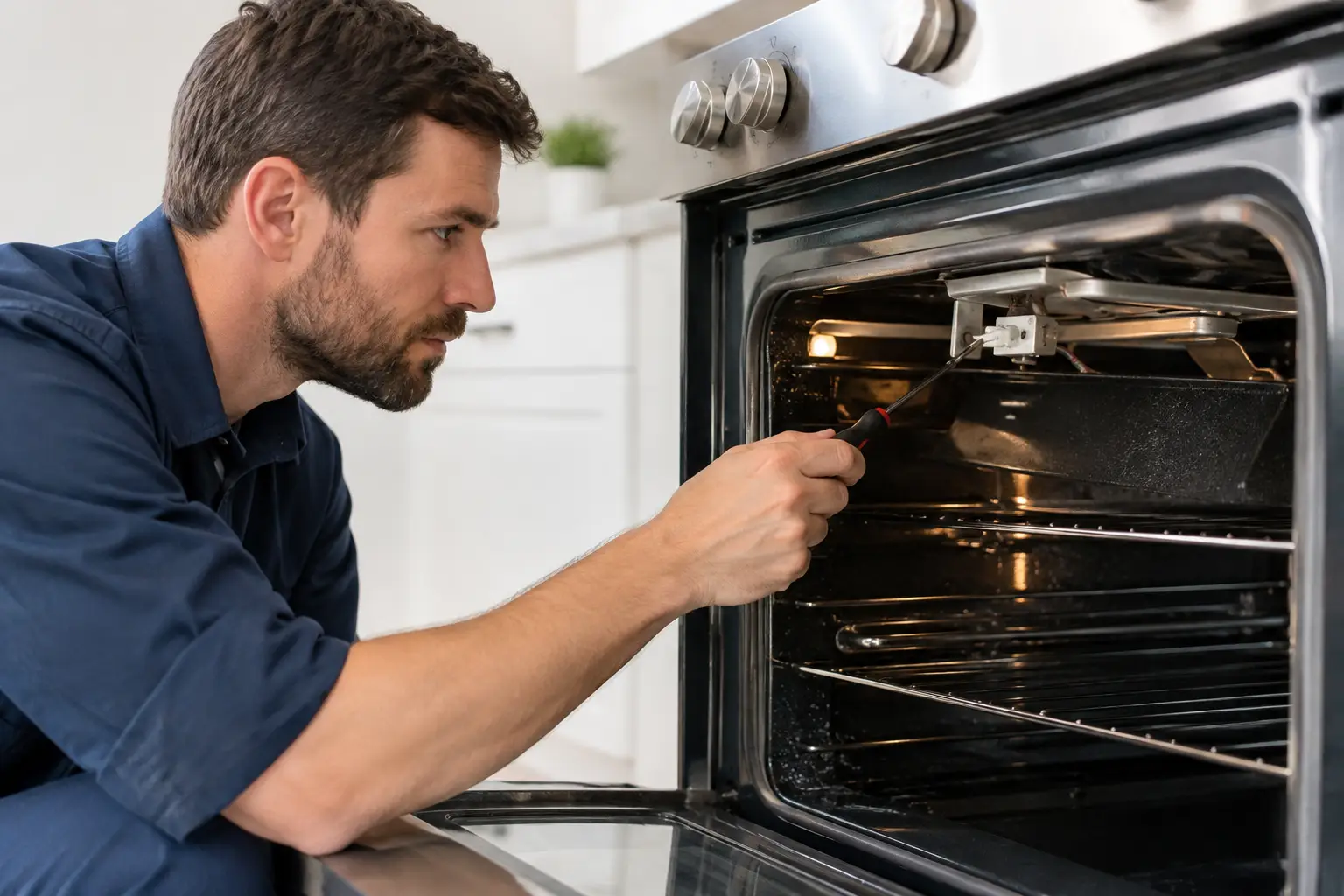
A gas oven that will not heat can bring dinner plans to a stop fast. You may hear the control click, see the display working normally, and even smell a brief trace of gas, yet the burner never lights. In many cases, the igniter is the issue. Knowing how to troubleshoot oven igniter problems can help you identify what is wrong, avoid unsafe guesswork, and decide when fast professional repair is the better call.
Most modern gas ovens use a hot-surface igniter, often called a glow-bar igniter. It sits near the bake burner and glows orange or red as it heats. Once it reaches the right temperature and draws enough electrical current, the gas safety valve opens and the burner lights. A weak igniter can glow and still fail to open the valve, which is why a visible glow does not always mean the igniter is working properly.
Not Sure You Need a Repair?
Before you pay for a service call, try FixDecision AI. Describe what's wrong with your appliance and get a safety-first assessment to help you decide whether to DIY or call a professional.
Start With Basic Oven Safety
Before inspecting anything, turn the oven off and allow it to cool completely. If you smell a strong or persistent gas odor, do not try to light the oven, test components, or flip electrical switches. Leave the area, shut off the gas supply only if it is safe to do so, and contact your gas utility or emergency services from outside the home.
For ordinary no-heat problems without a gas odor, disconnect electrical power before removing oven panels. Unplug the range if you can reach the plug safely. Otherwise, switch off the appliance circuit breaker. Gas ovens use electricity for their controls, igniter, and safety systems, so this step matters even when the appliance is connected to a gas line.
Avoid touching the igniter element with bare fingers. The material is fragile, and oils from skin can shorten its life. If you need to handle it during an inspection, use clean gloves and work carefully.
How to Troubleshoot Oven Igniter Symptoms
The best clue is what the oven does after you set it to Bake. Reconnect power only for the observation, keep the oven empty, and watch through the door or opening without placing your hands near the burner.
The igniter does not glow at all
If the igniter stays dark, the problem may be the igniter itself, but it is not the only possibility. A failed bake element control relay, damaged wiring, a loose connector, a faulty oven control board, or a blown thermal fuse can also prevent power from reaching it.
First, confirm the range has power. Check whether the display, oven light, clock, and surface burners operate. If the display is blank or multiple functions are dead, look for a tripped breaker or power-supply issue before focusing on the igniter.
If the broiler works but the bake function does not, that narrows the problem. Many ovens use separate bake and broil igniters. A working broiler with a dark bake igniter often points to a failed bake igniter or a problem in the bake circuit. At this stage, a technician can test for voltage and continuity safely rather than replacing parts by guesswork.
The igniter glows, but the burner never lights
This is one of the most common gas oven failures. A hot-surface igniter can become weak over time. It may still glow bright orange, but it no longer draws the electrical current needed to open the gas valve. The result is an oven that appears to be trying to start but never produces heat.
Give the oven a few minutes, but do not let it attempt ignition indefinitely. If it repeatedly glows without lighting, turn it off. Continued attempts can create stress on components and may allow an unburned gas odor to build up.
A worn igniter is often the likely repair when the glow bar works but the burner does not light. Still, a restricted burner, failed safety valve, wiring issue, or control problem can produce similar symptoms. Proper diagnosis matters because replacing a part that is not at fault adds cost without getting the oven back up and running.
The burner lights slowly or takes too long to preheat
A healthy oven burner generally ignites within about 30 to 90 seconds after Bake is selected, though timing varies by model. If it takes several minutes to light, preheating drags on, or the oven reaches temperature inconsistently, a weakening igniter is a strong possibility.
Pay attention to changes in cooking performance. Longer bake times, uneven browning, and recipes that suddenly need extra time may mean the oven is struggling to maintain the selected temperature. The igniter may be part of the problem, but the temperature sensor or control system could also be involved.
The burner lights, then shuts off or heats unevenly
An oven burner should produce an even, steady flame once it lights. Flames that are unusually yellow, uneven, or limited to one section can point to dirty burner ports, a burner positioned incorrectly, or a gas-pressure issue. This is not automatically an igniter failure.
With power and gas shut off, you can inspect for obvious food debris or grease around the burner area. Do not enlarge burner openings with a toothpick, drill bit, or sharp object. Damaging the ports can make combustion less reliable. If cleaning does not clearly solve a visible blockage, schedule service.
Check the Parts You Can See
After disconnecting power again, remove the oven racks and the bottom panel if your model allows straightforward access. On many ranges, the bake burner and igniter are beneath this panel. Look for a cracked igniter, broken ceramic base, scorched wire insulation, loose connections, or heavy buildup around the burner.
A damaged igniter should be replaced, not repaired. Its heating element is not a part that can be patched safely. If the igniter appears intact, that does not rule it out. Many failed igniters look normal and require electrical testing to confirm their condition.
Also check the burner alignment. If the burner shifted during cleaning or a prior repair, gas may not flow correctly around the igniter. Reinstall any panels and screws exactly as they were. Loose metal panels can rattle, affect airflow, or create future service headaches.
Know the Difference Between Oven Ignition Systems
Not every gas oven uses the same setup. Most full-size modern ranges have a hot-surface glow igniter inside the oven cavity. Some older models and certain specialty appliances use a spark ignition system instead. Those systems produce an audible clicking sound and a visible spark rather than a glowing bar.
A clicking oven that will not ignite may have a dirty electrode, failed spark module, poor ground, moisture around the igniter, or a gas-supply problem. The troubleshooting path is different, so avoid ordering a glow-bar igniter based only on the word “igniter.” Find the model number, usually located around the oven door frame, storage drawer area, or appliance paperwork, before identifying replacement parts.
When a Professional Repair Is the Smart Move
Replacing an accessible hot-surface igniter can be a manageable repair for an experienced homeowner who has the correct model-specific part and is comfortable disconnecting electrical connectors. But it is not the right do-it-yourself job for everyone. Igniters are brittle, wiring can be difficult to access, and gas appliances require careful reassembly and testing.
Call for qualified appliance repair help if you notice a gas smell, repeated ignition failures, damaged wires, breaker trips, burner flame problems, error codes, or uncertainty about the diagnosis. A certified technician can test the igniter’s electrical performance, confirm whether the gas valve and control board are operating correctly, and make sure the oven lights and heats safely.
Repair costs depend on the oven brand, part accessibility, local labor rates, and whether the issue is limited to the igniter. An igniter replacement is often less expensive than major control-board or gas-valve work. For an otherwise dependable oven, repairing a failed igniter is commonly worthwhile. If the appliance is older and has several recurring problems, ask for a clear repair estimate before deciding whether replacement makes more sense.
Help Prevent Future Igniter Trouble
Keep spills from accumulating under the oven floor, especially after baking pies, casseroles, or foods that bubble over. Regularly wipe the cavity once it is cool, and avoid spraying cleaner directly on burner or igniter components. Use the self-clean cycle only as recommended by the manufacturer, since extreme heat can be hard on aging oven parts.
If your oven begins taking longer to preheat, do not wait until it fails completely before addressing it. Early service can reduce disruption and help get the appliance repaired correctly the first time. When the diagnosis is unclear or a gas appliance does not feel safe to operate, US Appliance Repairs can help connect you with local repair professionals who can restore reliable heat and give you greater peace of mind.