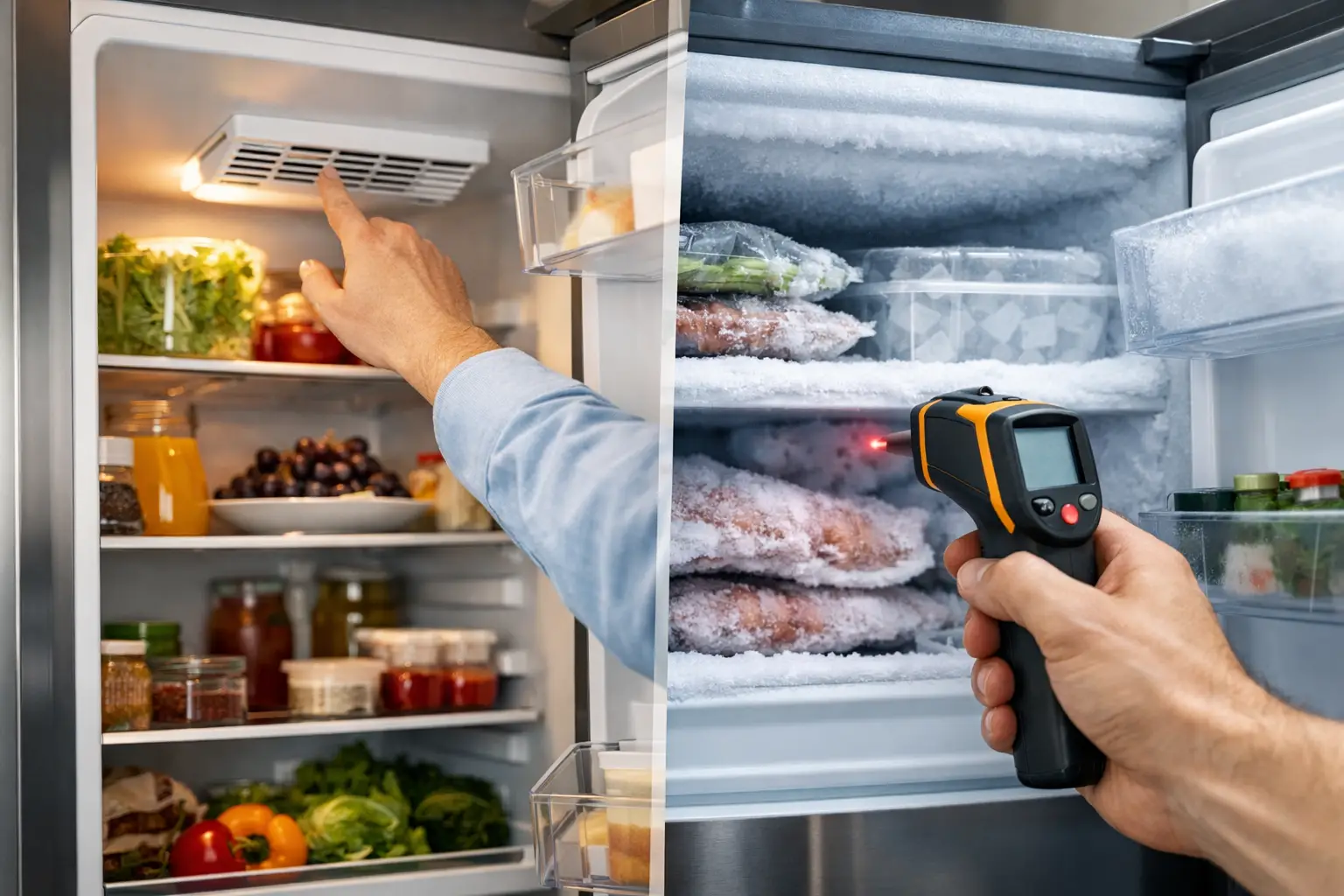
A refrigerator warm freezer cold problem can turn into a food-safety issue faster than most homeowners expect. Your freezer may still make ice and keep frozen food solid while milk, leftovers, and produce in the refrigerator section drift above a safe temperature. Before moving food around or assuming the entire appliance has failed, take a few focused steps to protect your groceries and identify whether you need fast repair help.
Refrigerator warm but the freezer still cold? Run the free guided diagnosis — it screens for safety first, then walks you through the likely causes (airflow, vents, damper, defrost system) and tells you honestly when to call a pro. Start the refrigerator diagnosis →
Start With Food Safety and Temperature Checks
Place an appliance thermometer in the refrigerator section if you have one. The refrigerator should generally stay at or below 40°F, while the freezer should be at 0°F. If refrigerated perishables have been above 40°F for more than two hours, use caution. If the temperature has been above 40°F for four hours or longer, meat, dairy, cooked leftovers, eggs, and other perishable foods should usually be discarded.
Move high-risk food to a cooler with ice if possible. Keep the refrigerator and freezer doors closed as much as you can while you investigate. Repeatedly opening the door lets in warm, humid air and makes a marginal cooling problem worse.
A cold freezer is encouraging, but it does not mean the refrigerator section is working correctly. In many models, both compartments rely on the same cooling system. The freezer creates the cold air, and fans, vents, dampers, and controls distribute some of that air into the fresh-food compartment.
Why Is the Refrigerator Warm but the Freezer Cold?
The most common cause is an airflow problem. Cold air is being made in the freezer, but it is not reaching the refrigerator compartment in the amount needed to hold a safe temperature. A blocked vent, failed evaporator fan, stuck air damper, or frost-covered evaporator coil can all cause this pattern. Frost that keeps returning inside the freezer is worth investigating — see what causes frost buildup in a freezer.
Less commonly, the refrigerator controls may be set incorrectly, a door gasket may be leaking, or a sensor or control board may be sending the wrong signal. The right repair depends on the model and what the appliance is doing, which is why a quick diagnosis can prevent spending money on the wrong part.
Blocked Air Vents
Look inside both compartments for supply and return vents. Their location varies by model, but they are often along the rear wall, top panel, or sidewalls. Overpacked shelves, tall containers, grocery bags, or frozen food pushed against the back wall can restrict circulation.
Rearrange food so air can move freely around the vents. Do not pack the freezer tightly against its rear panel. A freezer works best when it is reasonably full but not crammed so tightly that air cannot circulate.
A Stuck or Failed Air Damper
Many refrigerators use a damper assembly to regulate the cold air flowing from the freezer into the refrigerator. When the damper is stuck closed, the freezer remains cold while the refrigerator warms up. You may hear the appliance running normally but feel little or no cold air coming from the refrigerator vent.
Some dampers are mechanical, while others are controlled by a small motor or electronic board. Accessing and testing the assembly may require removing interior panels. For most homeowners, this is a good point to schedule a certified appliance technician rather than force parts that can crack or break.
Frost Blocking the Evaporator Coil
Behind the freezer’s interior rear panel sits the evaporator coil, where cold is produced. During normal operation, the refrigerator periodically defrosts this coil. If the defrost heater, defrost thermostat, sensor, timer, or control system fails, frost can build into a thick layer of ice.
That ice prevents air from moving across the coil and into the refrigerator compartment. Common clues include a snowy or heavily frosted freezer back wall, declining refrigerator temperatures, and a freezer that seems cold at first but gradually performs less effectively.
Unplugging the refrigerator and allowing it to thaw can temporarily restore airflow, but it does not fix the component that caused the ice buildup. If the problem returns after a day or two, the appliance needs diagnosis and repair.
An Evaporator Fan Problem
The evaporator fan moves cold air across the freezer coil and through the appliance. When it stops working, the freezer may still feel cold near the coil, but the refrigerator section often becomes warm first.
Open the freezer door and listen. On many models, the fan pauses when the door is open, so hold the door switch closed for a moment and listen for a fan running. Do not insert fingers or tools near fan blades. A fan that is silent, noisy, or rubbing against ice is a strong reason to call for service.
Not sure which of these causes matches what your refrigerator is doing? The guided diagnosis helps you narrow it down one safe step at a time. Run the refrigerator diagnosis →
Safe Checks You Can Do Before Calling
A few basic checks can solve simple issues without taking the refrigerator apart. Work through these steps with the appliance plugged in unless a step specifically requires unplugging it:
- Confirm the temperature controls were not accidentally changed. Set the refrigerator near 37°F and the freezer near 0°F, then allow up to 24 hours for stable temperatures after an adjustment.
- Make sure interior vents are open and not blocked by food, bins, or packaging.
- Check that both doors close fully. Clean sticky spills from the gasket and inspect it for tears, gaps, or sections pulling away from the door.
- Clean dust, pet hair, and debris from accessible condenser coils or the lower grille area. Unplug the appliance first if you need to remove a panel.
- Look for excessive frost on the freezer’s back interior panel and listen for unusual clicking, buzzing, grinding, or fan noise.
Do not chip ice with a knife, screwdriver, or sharp object. It is easy to puncture a refrigerant line or damage an interior liner, turning a repairable airflow issue into a much more expensive problem. Avoid removing sealed-system components or handling electrical wiring unless you have the training and tools to do so safely.
If the refrigerator stays warm even after the safe checks, run the guided diagnosis — it will also flag when a technician is the right call. Start the free refrigerator check →
When to Schedule Refrigerator Repair
Call a qualified appliance repair technician promptly if the refrigerator remains above 40°F after basic airflow checks, if the freezer wall is heavily frosted, or if you cannot hear the evaporator fan operating. Service is also the practical choice when the refrigerator is repeatedly cycling, displaying an error code, leaking water, or making loud mechanical noises.
A technician can check airflow, test the fan motor and damper, inspect the defrost system, and determine whether sensors or electronic controls are functioning properly. This targeted approach matters because several failures can create the same refrigerator-warm, freezer-cold symptom.
For homeowners who need help quickly, US Appliance Repairs can help connect you with an independent local provider for refrigerator diagnosis and repair. The goal is to get clear answers, protect your food, and get the appliance back up and running without the stress of screening service companies on your own.
Repair or Replace: What Makes Sense?
A failed fan motor, defrost component, door gasket, or air damper is often worth repairing, particularly when the refrigerator is otherwise in good condition. The decision gets more complicated with older units that have repeated breakdowns, major control-board issues, or sealed-system problems involving the compressor, refrigerant lines, or evaporator coil.
Age, repair cost, appliance size, and overall condition all matter. A newer refrigerator with a straightforward airflow failure generally has a better repair case than a near-end-of-life unit with multiple expensive issues. Ask the technician for the diagnosed cause, the expected repair cost, and whether the repair addresses the underlying failure rather than only the symptom.
Prevent the Next Cooling Problem
Keep vents clear, clean accessible coil areas periodically, and avoid holding doors open while unloading groceries. Check door gaskets occasionally, especially if the refrigerator sits near a busy kitchen walkway where doors are often bumped or left slightly ajar.
Most importantly, do not wait for food to feel noticeably warm before acting. A thermometer in the refrigerator can reveal a slow cooling problem early, giving you more time to save groceries and arrange reliable repair help before a small airflow issue becomes a full kitchen emergency.